Although the number of college students who have mental illness has recently gone down, about one in five Americans is diagnosed with it each year, according to the National Institute of Mental Health (NIMH).
Did you know that mental illness can impact the outcome of a case and the administration of justice in the legal system? As such, it can be a key component to their defense strategy.
A bipolar disorder criminal defense lawyer understands such situations very well. They are experts in effectively integrating mental health considerations into your legal defense. But this needs proper evaluations and assessments before it can be accepted in court.
Let’s examine how mental health can affect judgments, sentencing, and legal outcomes.
Table of Contents
- 1 The Insanity Defense: Historical Context and Evolution
- 2 Landmark Cases Shaping Mental Health Defense
- 3 Understanding Psychological Disorders in Legal Context
- 4 The Role of Expert Testimony in Mental Health Cases
- 5 Challenges in Proving Mental Health Defenses
- 6 Impact on Victims and Families
- 7 Ethical Considerations in Mental Health Legal Defenses
- 8 Future Directions: Mental Health and the Justice System
The Insanity Defense: Historical Context and Evolution
You may be surprised how the concept of insanity has been used as a legal defense since the ancient period.
Historically, people believed in some gods or a force beyond human understanding. As such, the courts would not be astonished by odd or inexplicable actions. In fact, during the 19th century, the legal system started to recognize the distinctions between sanity and insanity.
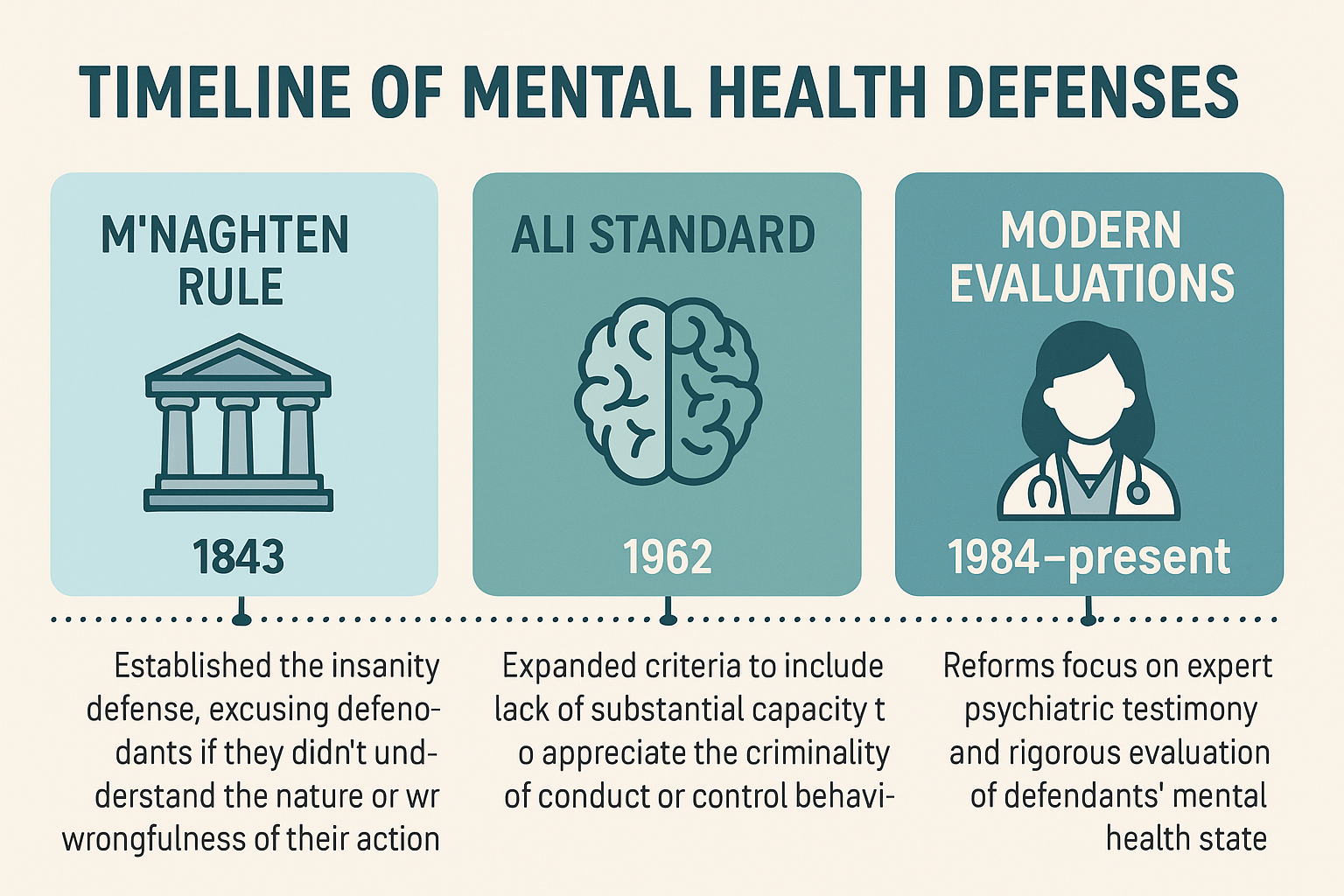
One of the most important cases in this respect is the trial of Daniel M’Naghten in 1843. M’Naghten has shot and killed the secretary of the Prime Minister due to delusions caused by his mental illness. He was sentenced “not guilty by reason of insanity” and was sent to a mental institution, where he stayed for the rest of his life.
This case has established the M’Naghten Rule, which has now been adopted by many jurisdictions in various forms. Generally, it is concerned with the mental state of the accused at the time of the crime in relation to their capability to discern between right and wrong.
Today, the insanity defense is considered one of the most common types of criminal defense. This is because it directly addresses the defendant’s mental state and capacity to understand the nature of their actions. With time, the courts have revised the criteria according to their perceived knowledge of mental illness at the time.
Today’s insanity pleas bring out the defendant’s mental health as well as its influence on the conduct, thereby making it necessary to consider the connection between law and psychiatry in the determination of responsibility.
Landmark Cases Shaping Mental Health Defense
In criminal law, the evaluation of mental health has been affected by a number of landmark cases. The trial of Daniel M’Naghten supplied the criteria for the investigations into cognitive awareness and moral comprehension.
On the other hand, John Hinckley Jr.’s trial in 1981 is one of the cases that gave rise to broader standards in the 20th century. It was tested based on the American Law Institute (ALI), which took into account both the cognitive and the volitional capacities.
In these trials, the courts tried to find a middle ground between the legal accountability of the defendants while acknowledging their mental disorders. Part of this is underlining the necessity for expert evaluation in difficult cases.
Understanding Psychological Disorders in Legal Context
Among others, psychological disorders can alter one’s ability to make decisions, control impulses, and understand what is right and wrong. The judicial system takes into account the characteristics and the degree of the disorder when judging the person’s guilt.
Nonetheless, there are mental disorders that do not reduce the legal responsibility of the individual at all; rather, some mental disorders are situation and functional capacity dependent and thus allow total accountability.
The comprehension of such complexities gives rise to the reasoning behind the fact that mental health evaluations are an indispensable component of the evaluation of legal defenses and possible mitigation.
The Role of Expert Testimony in Mental Health Cases
In mental health cases, the expert witnesses like psychologists and psychiatrists, are inevitable. They give impartial evaluations regarding the defendant’s mental condition, which includes the examination of cognitive awareness, control over one’s behavior, and the extent to which the disorders can affect the actions.
These assessments are taken by the courts to decide whether the defendant was capable of comprehending the nature and consequences of their actions.
Challenges in Proving Mental Health Defenses
Mental health defenses confront multiple difficult situations. The limited knowledge of the jury and the judge about psychiatric conditions may lead to the appearance of doubts. No case study has been grounded, which alludes to symptomatic likeness; hence, the situation relies upon a set of criteria reflecting the state of the body with suitability and leniencies with which to do the same: no such standard has been presented.
Expert witnesses are often needed, but the process can be expensive and intricate. Besides, timing is a vital factor; if treatment is delayed or there is a lack of proper documentation, then the credibility of the case may be adversely affected.
The societal stigma associated with mental illness is another factor that could lead to misperceptions, thereby hindering the process of getting a fair verdict. The defense strategies that are to be considered successful will demand the execution of proper planning, the carrying out of detailed evaluation, and the conveying of psychological findings in a simplified manner.
Impact on Victims and Families
The use of mental health defenses can considerably influence not only the victims but also their relatives. The legal system’s assessment of the mental state of the defendant may, on the other hand, be a source of frustration, confusion, or even the feeling of being the second priority for the victims.
The courts and the legal experts have to be very careful in dealing with these sensitivities, and they have to recognize the emotional effect on the victims while at the same time guaranteeing the defendant’s fair trial rights.
Ethical Considerations in Mental Health Legal Defenses
Mental health cases place emphasis on ethical considerations. The legal system has to make a compromise between the defendants’ rights and the safety plus interests of the victims and the society.
Defense tactics should not impair accountability but rather grant an accurate portrayal of the defendant’s psychological state. Misrepresentation or overgeneralization of mental health issues can continue stigma and distort public perception, thus making it essential to adhere to the ethics.
Future Directions: Mental Health and the Justice System
With the rise of mental health awareness, the courts are now considering more and more the mental health aspect. The training of police and lawyers is getting better and better, which leads to early detection of disorders.
There are more and more customs such as diversion programs, which provide treatment-focused alternatives to incarceration, and mental health resources that are mandated by law in prisons.
These changes signify the incorporation of rehabilitation into justice along with punishment, which is now correctly seen as a very broad concept of justice.