Table of Contents
Introduction to Private Equity Fund Structures
Private equity funds stand at the forefront of alternative investments by pooling capital from a variety of investors to invest in private companies. This investment model often attracts institutions such as pension funds, endowments, family offices, and increasingly, high-net-worth individuals, all seeking higher returns than are typically available in the public markets. Investors looking to succeed in this space need to have a solid grasp of how private equity fund structures shape both risks and potential returns. It is not enough to place capital in the hands of a manager; understanding the mechanisms that govern fund operation, fee arrangements, profit-sharing, and liquidity options is critical for achieving risk-adjusted outcomes that meet portfolio mandates. For executives and professionals seeking guidance on navigating these evolving fund structures, True Platform, private equity executive search firms can help connect talent with impactful opportunities and provide a window into how hiring and leadership trends intersect with fund strategy in the sector.
The design of a private equity fund determines the relationship between fund managers and investors, affecting everything from capital commitments and fees to rights and obligations over the fund’s lifecycle. Trust, alignment of interest, and transparency are themes that underpin well-structured funds, and these elements become especially important in challenging economic cycles. As more sophisticated investor preferences emerge and market conditions evolve, fund sponsors have adapted by introducing a spectrum of innovative structures that address both liquidity concerns and long-term alignment. This evolution is leading to a richer toolkit for both seasoned investors and those newer to private markets, who are finding greater flexibility and customization than ever before.
Traditional Limited Partnership Model
The backbone of private equity remains the Limited Partnership (LP) structure. In this time-tested model, the fund is overseen by a General Partner (GP), who is responsible for deal sourcing, conducting due diligence, arranging financing, and overseeing the management of portfolio companies. The GP is typically deeply invested in the strategy’s success, often by committing its own capital alongside investors. Limited Partners, on the other hand, are primarily capital providers. They contribute funds but take a passive role in the investment process, relying on the GP’s expertise and judgment. Their liability is generally restricted to the amount invested, insulating them from losses beyond their contribution. Together, these roles create a balance between entrepreneurial agility and investor security, a model that has been refined over several decades and is still the benchmark for new fund launches. The clear delineation of responsibilities and liabilities is a major reason the LP structure remains dominant in the field.
Distribution Waterfall Mechanism
A defining feature of this model is the distribution waterfall, the sophisticated system that governs the sequencing and split of cash flows after an exit or liquidity event. This carefully constructed set of formulas ensures investors are rewarded before the fund managers benefit from outsized performance. Typically, distributions follow a three-layered approach that underpins the economic relationship between GPs and LPs:
- Return of Capital: First, LPs get back the money they invested in the fund. This prioritizes investor protection and limits risk by ensuring principal is returned before profits are considered.
- Preferred Return: LPs then receive an agreed-upon rate of return, often set near 8 percent, on their contributed capital. This “hurdle rate” must typically be met before managers can participate in profit splits, aligning incentives between parties and rewarding LPs for locking up capital in long-term, illiquid strategies.
- Carried Interest: Any remaining profits are split with the GP, usually granting them a 20 percent share (commonly called “carry”). This final stage is the GP’s main economic upside for successful management and the creation of substantial value, incentivizing strong performance and prudent risk-taking.
This model ensures managers are financially incentivized to maximize returns, but only after investors’ expectations are met. The sophistication of the waterfall structure also affords some flexibility, with additional features such as catch-up provisions or tiered carry rates in more advanced funds.
Emergence of Continuation Funds
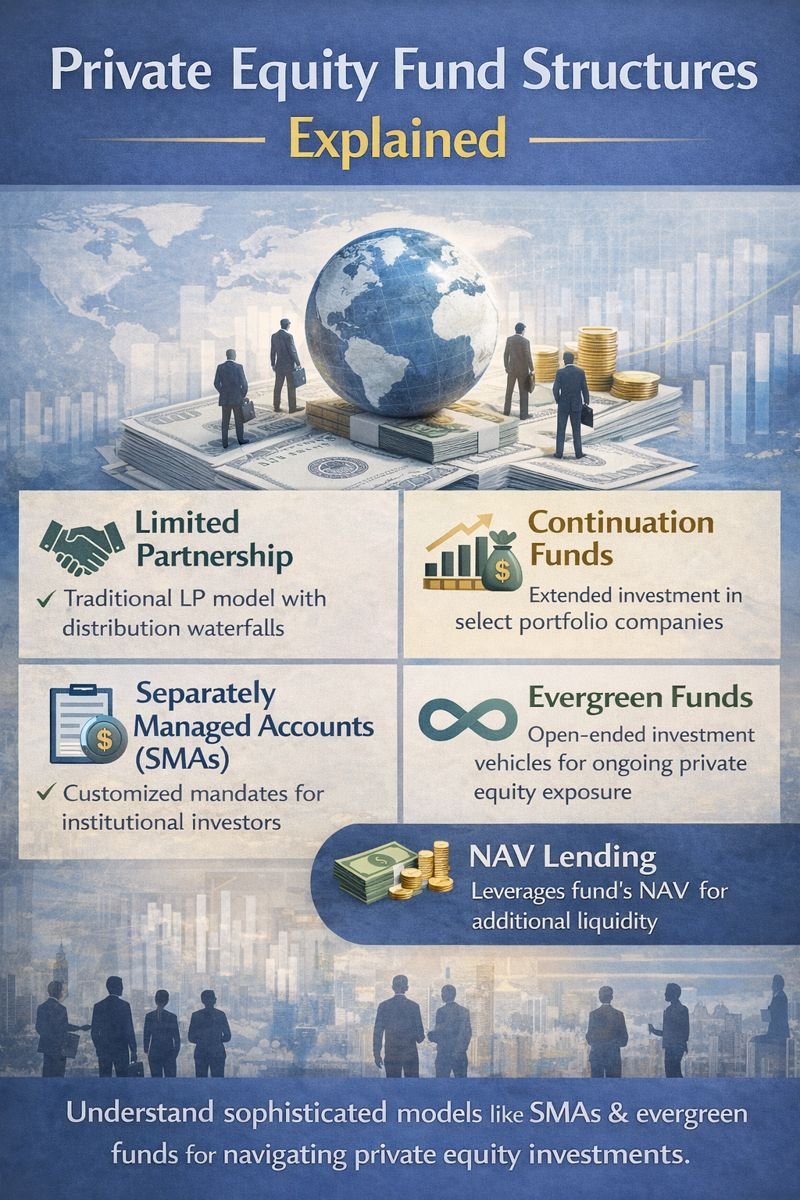
As the private equity market matures, new liquidity solutions have emerged to address market dynamics and investor demands. Among these, continuation funds stand out as a vehicle for General Partners to retain exposure to their most successful portfolio companies by moving select assets into a new fund, typically when the existing fund approaches its end of life. The value of this structure becomes evident when considering that some portfolio companies may need longer holding periods to realize their full growth or transformation potential. Continuation funds allow the GP to maintain oversight and operational involvement in prized assets, offering a powerful alternative to forcing an exit due to conventional fund term limits. This structure not only provides original LPs with liquidity options, allowing them to exit or reinvest, but also invites fresh capital and diverse investor profiles to participate in the continued growth of standout assets. Continuation funds have proven especially valuable during periods of economic uncertainty or market dislocation where traditional IPO and M&A exits are less viable. By offering flexible solutions, GPs may optimize value creation for both legacy and incoming investors.
Rise of Separately Managed Accounts (SMAs)
Another compelling option gaining traction among larger and more sophisticated institutional investors is the Separately Managed Account (SMA). Unlike traditional commingled funds, SMAs provide tailored exposure to the asset class and allow investors greater say over investment selection, risk allocation, sector preferences, and, in some cases, even the type of company, stage, or geography. This bespoke approach is a direct response to the growing demand from pension funds, endowments, and sovereign wealth funds for greater transparency, better alignment with their investment mandates, and enhanced customization of their private equity portfolios. For example, an investor with specific ESG goals or industry restrictions can set parameters within an SMA to match unique strategic or regulatory requirements. In addition, SMAs typically allow for more favorable fee negotiations based on commitment size, unique structural needs, or the complexity of investment oversight. With SMAs, institutions also gain improved data access, reporting, and control over liquidity profiles.
Introduction of Evergreen Funds
Unlike the traditional closed-end structure with a defined term (often around 10 years), evergreen funds operate as open-ended vehicles, raising and investing capital continuously. Investors can enter or exit these funds at scheduled intervals, often quarterly or semi-annually, without waiting for a pre-set dissolution date. This flexibility makes evergreen funds particularly appealing to those seeking ongoing access to private equity strategies, whether for portfolio rebalancing, matching cash flow needs, or capturing rolling investment opportunities. The open-ended nature of evergreen funds also means that capital deployment and harvesting can be more dynamic, allowing managers to adapt investment pacing to prevailing market opportunities. Their structure aligns well with investors who have long-term allocation targets for private assets or want to ensure more predictable liquidity windows. For investors with intergenerational objectives or who require ongoing private market exposure, evergreen funds address some of the classical illiquidity frictions that made private equity inaccessible except to those willing to lock up capital for a decade or more.
Utilization of Net Asset Value (NAV) Lending
Innovation in fund financing is further reflected in the advent of Net Asset Value (NAV) lending. This strategic tool enables GPs to borrow against the mark-to-market value of their funds’ portfolios, providing an alternative to traditional capital calls or asset sales when pursuing follow-on opportunities or actively managing distributions. NAV loans are generally used to support follow-on investments in portfolio companies, smooth out distributions to investors, such as prefunding liquidity or offsetting working capital shortfalls, or pursue new deals that might not align with the timing of incoming LP capital. By leveraging the net value of seasoned, high-performing investments, GPs can access non-dilutive liquidity, increasing fund operational flexibility and potentially enhancing returns for all stakeholders. As such, NAV lending has become an integral part of contemporary private equity fund management, especially in volatile markets where balancing liquidity, recycling capital, and meeting investor commitments is paramount. Lenders in NAV facilities tend to scrutinize fund performance, asset quality, and concentration risk, which brings an additional layer of discipline and oversight to fund operations.
Final Thoughts
The world of private equity is evolving rapidly, responding to increased investor sophistication and turbulent market environments. While the limited partnership model remains foundational for aligning managers’ and investors’ interests, newer models such as continuation funds, SMAs, evergreen funds, and NAV lending are helping investors and sponsors achieve closer alignment and greater flexibility in achieving specific investment outcomes. By understanding these structural options and their implications, investors can make more informed choices and better navigate the dynamic landscape of private equity. At the same time, GPs can continue adapting to stay competitive in a maturing, globally interconnected financial landscape.