In today’s fast-paced and highly competitive market for custom cabinetry, achieving high-quality finishes alongside efficient, timely output has become more important than ever for both large-scale manufacturers and small, independent shops. With the advent of modern industrial edge banding machine technology, cabinet makers now have access to advanced automation that streamlines the once labor-intensive process of applying edge banding to panels. This not only reduces manual labor costs but also eliminates inconsistencies and human error that previously slowed production and led to costly rework.
As CNC edge banders become integral to cabinet shops, they enhance production by offering greater consistency, accuracy, and the ability to manage complex orders with minimal manual effort. This technology boosts both the speed and quality of custom cabinetry, enabling manufacturers to meet tight deadlines and adapt to design trends while reducing labor costs. It benefits both large manufacturers and smaller shops by improving efficiency and customization capabilities, thereby fostering innovation and flexibility within the cabinetry market.
Table of Contents
Precision and Consistency
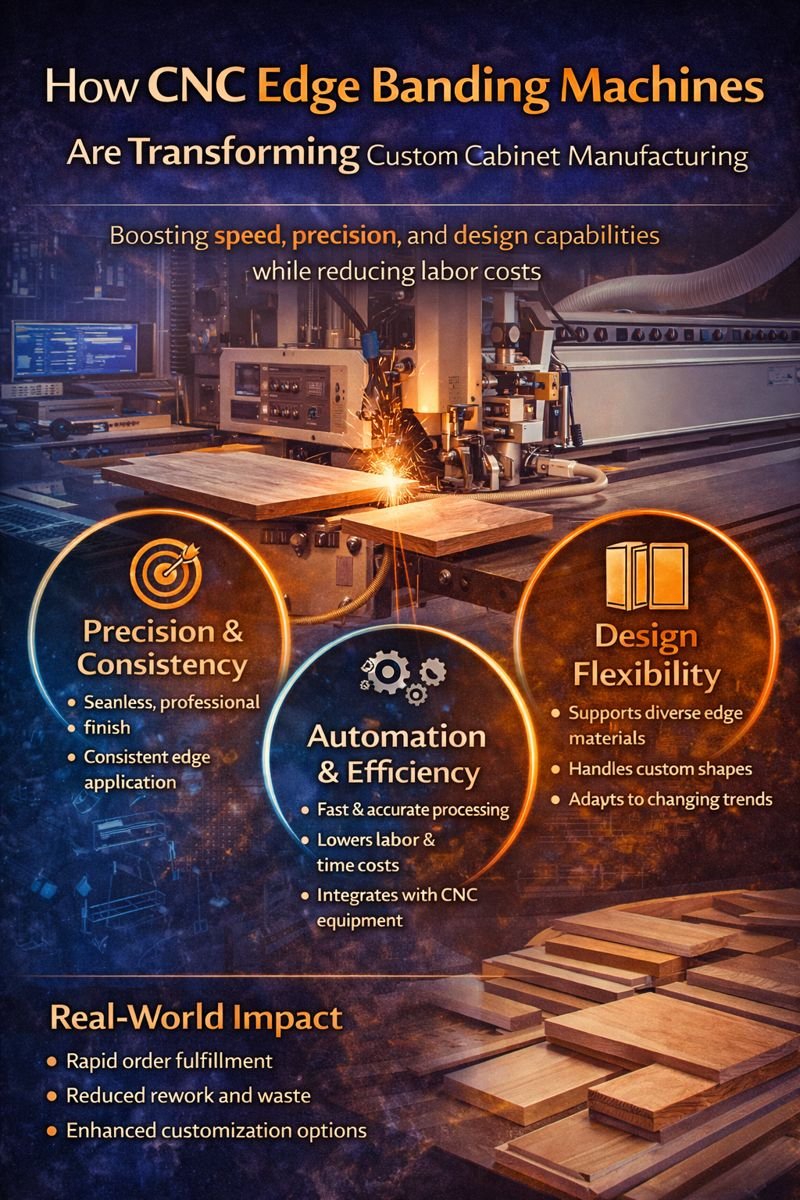
Precision is the cornerstone of quality cabinetry and a key factor that distinguishes professional-grade installations from amateur work. Manual edge banding, even when performed by an experienced craftsman, is prone to minor variations that add up, especially on large projects involving numerous panels or complex configurations. These imperfections can lead to visible seams, uneven adhesion, or inconsistent finishes—all of which reduce the cabinet’s overall appeal and longevity. CNC edge banding machines eliminate many of these traditional issues by automating the entire banding process. Programmed with exact measurements and parameters, these machines apply each edge band with meticulous accuracy, ensuring it fits flawlessly, bonds securely, and matches the desired aesthetic. The result is a superior product where every panel—regardless of size or shape—receives a professional, seamless finish. Such consistency matters more than ever, as demands for flawless craftsmanship have increased among homeowners, architects, and commercial clients alike. Over time, this repeatable quality also reduces the need for costly touchups or repairs, giving workshops higher confidence in their ability to deliver excellence with every project.
Automation and Efficiency
The steady evolution toward automation in woodworking and cabinet manufacturing represents a major leap forward in efficiency, productivity, and profitability. CNC edge banders are equipped with high-speed feeding, cutting, trimming, and gluing systems, all orchestrated by advanced software that not only automates repetitive tasks but also optimizes material usage and process sequencing. Because operators simply program the machine and load materials—rather than manually adjusting and applying the banding for each piece—it’s possible to process dozens or even hundreds of panels in the time it used to take for a handful of manually prepared pieces. This massive boost in throughput means shops can now take on more orders and larger projects without the need for costly increases in workforce. Moreover, automated edge banders are designed to reduce errors by factoring in panel thicknesses, corner details, and adhesive application—all of which are managed with real-time feedback systems that catch issues before they affect final quality. Feeding times and setup intervals can be slashed by up to 30%, freeing up skilled labor for high-value tasks elsewhere in the shop.
Design Flexibility
Modern consumers seek unique cabinetry solutions that reflect their personal style, whether that means bold new colors, unusual shapes, or eco-friendly materials. CNC edge banding machines address this need for customization by supporting a wide range of edge materials, including ABS, PVC, melamine, wood veneer, and even specialty decorative strips, across various thicknesses and finishes. This flexibility would be nearly impossible to achieve at scale with manual labor, given the complexity involved in swapping materials, adjusting application settings, or ensuring adhesion on challenging curves or profiles. With CNC edge banders, however, shop operators simply select the desired program and the machine adapts automatically. Whether handling a one-off custom kitchen, a designer retail fit-out, or a full commercial project, manufacturers can transition seamlessly from one style to another. Changes that once required hours of retooling or trial and error can now be accomplished in minutes. This capability not only streamlines small custom runs but also keeps mass production lines agile enough to respond to fast-changing trends and client requirements—giving shops a critical edge in a design-driven marketplace.
Integration with CNC Technologies
A major advantage of CNC edge banding machines lies in their ability to integrate smoothly with a range of other CNC-powered woodworking technologies. In modern cabinet shops, it is increasingly common to connect edge banders with CNC routers, panel saws, and automated drilling machines, creating an interconnected manufacturing “cell” where panels can move automatically from one stage to the next with minimal human intervention. This full-spectrum approach to CNC automation eliminates unnecessary delays, bottlenecks, or handling errors that interrupt production in more traditional shops. For example, a kitchen cabinet panel might be cut to size, drilled for hardware, banded at every edge, and finish-sanded—all in a continuous, software-driven sequence. Comprehensive integration offers granular process control, centralized data management, and the ability to monitor performance from a single dashboard, further enhancing efficiency and quality control. Ultimately, this convergence of CNC technologies represents the future of woodworking, where complete workflows are optimized for peak throughput, higher quality, and reduced labor overheads.
Real-World Applications
Reports from cabinet shops and furniture manufacturers who have adopted CNC edge banding are overwhelmingly positive. Success stories highlight the ability of these machines to transform operational capacities—cutting lead times, reducing waste, and dramatically improving margins on high-value projects. One of the most significant advantages is the confidence manufacturers can offer in promising timely delivery and consistent results, even for complex or unusual orders. Automated edge banding allows shops to fulfill rush jobs or intricate designs that previously might have exceeded their capacity, winning new business and strengthening customer loyalty. Whether it’s a residential kitchen renovation requiring multiple material finishes or a large-scale office build-out with unique cabinetry requirements, CNC edge banders have proven adaptable and reliable in every scenario. By minimizing rejected parts and reducing costly manual corrections, shops can focus resources on client engagement, product development, and business expansion—building a reputation for reliability and innovation in a crowded market.
Conclusion
The introduction of CNC edge banding machines is a game-changer for the production of custom cabinets. By driving advances in accuracy, speed, flexibility, and workflow integration, these machines provide manufacturers with the tools necessary to exceed client expectations and adapt quickly to a dynamic marketplace. As digital manufacturing and smart automation continue to progress, CNC edge banders are set to become increasingly essential to the cabinet and woodworking industries. These innovations empower businesses of all sizes to deliver quality, creativity, and efficiency—laying the foundation for the next generation of custom cabinetry and furniture design.