Commercial real estate (CRE) serves as a powerful engine for economic development, influencing local and national economies, job creation, and shaping the modern community. Beyond the tangible bricks and mortar, CRE drives business expansion, revitalizes neighborhoods, and supports infrastructure that is vital for daily operations. For those considering growth opportunities, working with a commercial real estate agent in Washington, DC, can provide invaluable local insight and connections, especially in dynamic urban markets like the nation’s capital.
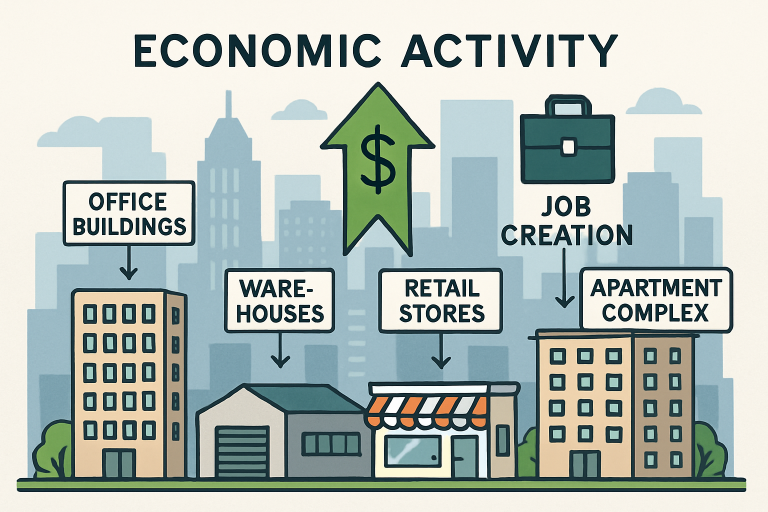
CRE encompasses various sectors, including office buildings, industrial parks, retail centers, apartment complexes, and data centers. These projects stimulate demand in construction, maintenance, real estate services, and numerous ancillary industries. The money invested, jobs created, and innovations introduced by commercial projects fuel both immediate and long-term economic prosperity. Thoroughly understanding the impact of CRE helps stakeholders—from business owners to city planners—recognize its value in supporting thriving communities.
Table of Contents
CRE’s Contribution to GDP and Employment
The commercial real estate sector is a vital pillar of the U.S. economy. In 2023, new commercial development and the daily operations of existing properties injected approximately $2.5 trillion into the national gross domestic product (GDP). This activity generated $881.4 billion in personal earnings and supported nearly 15 million jobs, underscoring the significant role CRE plays in economic well-being. These statistics are particularly telling when considering the ripple effect such investments create, ranging from construction workers and engineers to property managers and maintenance staff.
Industrial and Logistics: The Powerhouses of Growth
E-commerce continues to transform global supply chains, resulting in a surge in demand for logistics hubs, warehouses, last-mile delivery centers, and data centers. Companies prioritize speed and operational efficiency to meet the rising expectations of consumers. In markets such as Virginia, this shift is evident: industrial vacancy rates have reached historic lows thanks to a surge in new facilities and business relocations, benefiting both local economies and large corporations.
These trends highlight a fundamental evolution in the function and valuation of CRE assets. Properties catering to logistics, cold storage, and technology infrastructure are now among the most sought-after asset classes, reshaping investment priorities nationwide.
Technological Innovations Reshaping CRE
Technology is rapidly disrupting traditional commercial real estate practices. Artificial intelligence (AI) plays a significant role, from enhancing property valuation accuracy to predicting market shifts and automating asset management. Innovative building solutions, incorporating energy management, occupancy sensors, and predictive maintenance, drive operational savings and appeal to tenants seeking modern and efficient workspaces. These advancements not only increase the value and profitability of CRE assets but also attract sophisticated investors seeking scalable, technology-driven opportunities.
Proptech platforms and data analytics tools enable real-time decision-making, helping owners and managers optimize space utilization, respond to tenant needs, and maintain competitive portfolios in the face of rapidly changing market dynamics.
Sustainability: A New Asset Class Emerges
Environmental, social, and governance (ESG) considerations are fundamentally altering CRE strategies. Investors and occupants demand energy-efficient, net-zero carbon buildings that align with global sustainability targets and regulatory mandates. This transformation is driving the emergence of a new class of “net-clean” properties, which incorporate advanced insulation, efficient HVAC, and renewable energy solutions.
Implementing these eco-friendly modifications not only reduces operational costs but also enhances property value, tenant satisfaction, and long-term market resilience. CRE players with a strong sustainability profile are increasingly viewed as leaders in the transition toward a greener, more resilient built environment.
Regional Spotlight: Seattle’s Economic Surge
The role of CRE in fostering localized economic booms is clear in thriving metropolitan areas such as Seattle. From 2022 to 2023, the Seattle metro area led all major U.S. cities with a remarkable 6.2% growth in GDP. The area’s robust tech and information sector, fueled by continuous investment in office campuses and high-tech industrial facilities, exemplifies the potential of strategic CRE investment to spark sustained regional prosperity.
Local leaders and real estate professionals point to Seattle’s mix of innovation-driven businesses and modern infrastructure as key contributors to its rapid rise, reinforcing the synergy between CRE development and economic performance.
Challenges and Market Sentiment
Despite its strong fundamentals, CRE is not immune to macroeconomic headwinds. The first quarter of 2025 witnessed a significant decline in market sentiment, primarily attributed to the implementation of new tariff policies and heightened geopolitical uncertainties. Such shifts underscore the inherent sensitivity of CRE to changes in economic policy and global events, necessitating that investors and operators adopt adaptable and resilient strategies.
As fiscal environments shift, stakeholders must remain agile, leveraging technology and diversifying investment strategies to mitigate risk and capitalize on emerging opportunities.
Conclusion
Commercial real estate remains a vital driver of economic growth and innovation. Its influence permeates national and local economies, generates millions of jobs, and is continuously reshaping itself through technology and sustainability initiatives. By understanding key market drivers and adapting to new challenges, CRE professionals and investors can position themselves to thrive in a landscape where adaptability and forward-thinking are essential for long-term success.