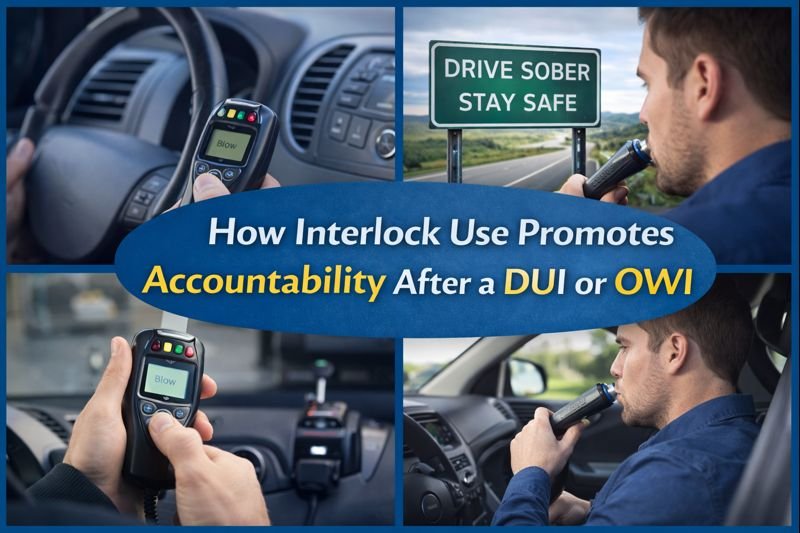
Driving under the influence or while intoxicated is a serious offense with far-reaching consequences. Beyond legal penalties, a DUI or OWI can disrupt employment, family responsibilities, and personal independence. In this context, the use of interlocks plays a critical role in supporting accountability following an offense. Rather than serving as a simple restriction, interlocks create a framework that encourages responsibility, compliance, and long-term behavioral change while prioritizing public safety.
Table of Contents
- 1 Accountability as a Core Goal After a DUI or OWI
- 2 Reinforcing Safer Driving Decisions
- 3 Demonstrating Compliance With Legal Requirements
- 4 Supporting Rehabilitation Over Punishment Alone
- 5 Encouraging Self-Reflection and Behavior Change
- 6 Protecting Public Safety Through Personal Responsibility
- 7 Rebuilding Trust With Family and Community
- 8 Accountability That Extends Beyond the Court Order
Accountability as a Core Goal After a DUI or OWI
Accountability is a central principle in post-conviction requirements. Courts aim not only to penalize but also to reduce the likelihood of repeat offenses. The use of an Ignition Interlock Device aligns with this goal by placing responsibility directly on the individual every time they attempt to drive. Each interaction with the device reinforces the understanding that driving is a privilege tied to sober decision-making.
Unlike passive penalties, such as fines or license suspensions alone, interlocks require daily, active compliance. This repeated action builds awareness and reinforces the consequences of choices, making accountability an ongoing process rather than a one-time punishment.
Reinforcing Safer Driving Decisions
One of the most significant ways interlock use supports accountability is by creating a clear boundary between drinking and driving. The presence of the device removes ambiguity and excuses, making it impossible to ignore the legal and personal responsibility to drive sober. This boundary encourages individuals to plan—whether that means arranging alternative transportation or choosing not to consume alcohol when driving is anticipated.
Over time, these decisions can evolve into habits. By repeatedly making sober choices to meet interlock requirements, individuals begin to internalize safer behaviors that extend beyond the period of court oversight.
Demonstrating Compliance With Legal Requirements
After a DUI or OWI, individuals are often required to prove adherence to court orders. Interlock use provides a tangible, verifiable way to demonstrate compliance. The device records usage and activity, creating an objective record that authorities can review.
This documentation benefits both the justice system and the individual. For courts, it offers assurance that conditions are being met. For individuals, it provides evidence of responsibility and progress. This transparency can play a crucial role in meeting legal milestones, such as license reinstatement or the completion of probationary periods.
Supporting Rehabilitation Over Punishment Alone
Accountability is most effective when paired with opportunities for rehabilitation and support. Interlock use supports this balance by allowing individuals to maintain essential mobility—such as commuting to work, attending required programs, or caring for family—while still enforcing strict safeguards.
This approach acknowledges that long-term change is more likely when people are supported in rebuilding their lives responsibly. Interlocks enable individuals to continue daily activities without compromising safety, reinforcing the idea that accountability and rehabilitation can coexist.
Encouraging Self-Reflection and Behavior Change
Each interaction with an interlock serves as a moment of self-reflection. The requirement to demonstrate sobriety before driving prompts individuals to consider their choices and their consequences. Over time, this repeated reflection can lead to deeper awareness of patterns related to alcohol use and decision-making.
Accountability, in this sense, becomes an internalized concept. Rather than acting responsibly only to meet external requirements, individuals may begin to value sober driving as a personal standard. This shift from external enforcement to internal motivation is a key factor in reducing repeat offenses.
Protecting Public Safety Through Personal Responsibility
At its core, accountability after a DUI or OWI is about protecting others on the road. Interlock use directly supports public safety by ensuring that only sober driving occurs under court-ordered conditions. This protection extends beyond the individual to passengers, pedestrians, and other drivers.
By placing responsibility in the hands of the person who committed the offense, interlocks reinforce the connection between individual actions and community well-being. This connection is a powerful reminder that accountability is not just a legal obligation, but a social one.
Rebuilding Trust With Family and Community
A DUI or OWI can strain relationships and erode trust. Interlock use can serve as a visible commitment to change, signaling to family members, employers, and the broader community that the individual is taking responsibility seriously. Consistent compliance demonstrates reliability and respect for safety, which can be essential in repairing damaged relationships.
This restored trust often plays a meaningful role in long-term success. When individuals feel supported and recognized for their efforts, they are more likely to continue making responsible choices.
Accountability That Extends Beyond the Court Order
While interlock requirements are time-limited, the accountability they foster can have lasting effects. The habits formed, the awareness gained, and the trust rebuilt do not automatically disappear when the requirement ends. For many, the experience becomes a turning point that reshapes attitudes toward alcohol, driving, and personal responsibility.
In this way, interlock use is not just about meeting a legal requirement—it is about creating a structured environment where accountability is practiced daily. By combining enforcement with opportunity for growth, interlocks support safer roads and more responsible drivers long after a DUI or OWI is in the past.