Industrial vacuum technology has become a foundational element of modern facility infrastructure. No longer viewed solely as auxiliary equipment, today’s vacuum solutions address complex industrial needs and deliver essential benefits in productivity, sustainability, and safety. The market’s evolution has driven demand for specialty systems, including hydro excavation vacuum equipment that combines power, precision, and reduced environmental impact.
This rising interest in sophisticated vacuum systems comes as industries seek smarter, more adaptable tools to meet fast-changing demands. Automated operation, AI integration, and eco-friendly technologies are setting the new industry standard. As infrastructure projects grow larger and more complex, and industries such as healthcare and manufacturing demand ever-increasing precision, advanced vacuum solutions are increasingly underpinning essential operations worldwide.
The infrastructure sector has embraced these technologies not just to replace outdated systems, but also to unlock new efficiencies and capabilities. For example, adopting vacuum excavation methods in civil construction reduces utility strikes and surface disruptions, improving job safety and public satisfaction.
Table of Contents
Advancements in Vacuum Technology
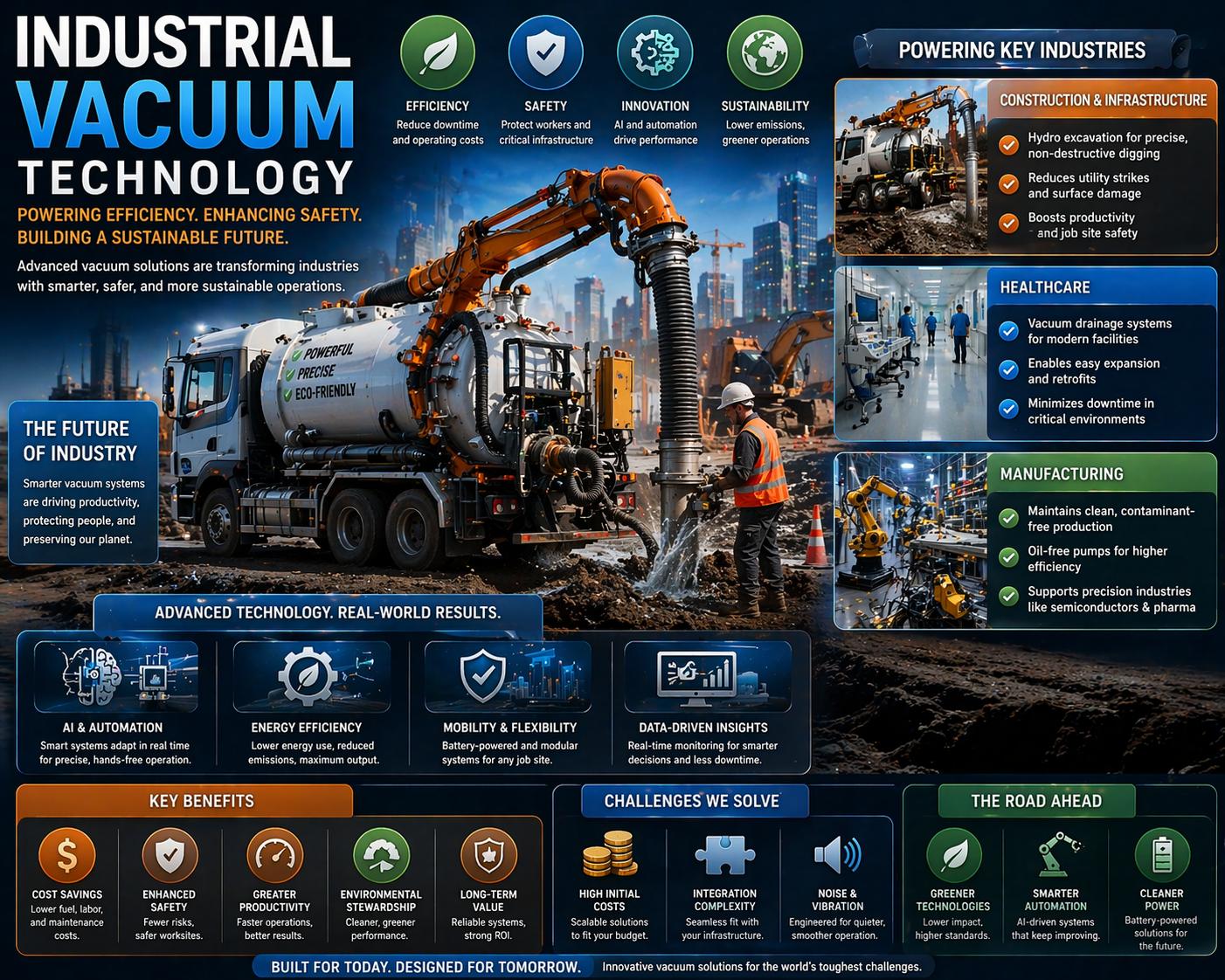
Vacuum technology is advancing rapidly. Automation and artificial intelligence (AI) are at the forefront, enabling more precise operations and task adaptability. AI-powered vacuum lifters adjust to diverse loads and materials, enabling safe, efficient handling with less manual involvement. This is particularly important in highly technical or sensitive industrial environments such as electronics manufacturing or material handling, where errors can result in significant losses or safety issues.
Applications in Construction and Infrastructure
The construction sector has become an enthusiastic adopter of advanced vacuum technology. These solutions have improved both safety and operating efficiency, especially as projects become more complex and urban job sites grow more congested. A real-world example is Kokosing Construction’s use of the Hurricane 600 Conveyor Vacuum system, which allowed microtrenching crews to offload spoils directly into dump trucks rather than cumbersome vacuum trucks. This not only sped up production but also reduced project delays and manpower requirements, resulting in significant time and cost efficiencies. As cities modernize, such enhancements are essential for reducing overall disruptions and ensuring the smooth progression of infrastructure upgrades.
Healthcare Sector Innovations
In healthcare, the flexibility and reliability of vacuum solutions are revolutionizing both facility designs and day-to-day operations. Traditional gravity-based drainage systems are increasingly giving way to vacuum drainage systems, which offer crucial adaptability for ever-evolving hospitals and clinics. Modern medical facilities can expand, reconfigure, or retrofit spaces with minimal disruption thanks to vacuum-based plumbing and waste management systems. This adaptability is especially valuable for older structures and in critical care areas where operational downtime is not an option.
Manufacturing Industry Integration
Manufacturing processes are leveraging advanced vacuum systems to guarantee quality and consistency for high-precision work. In fields such as semiconductor fabrication or pharmaceutical manufacturing, vacuum technology is critical for maintaining pristine, contamination-free environments. Innovations such as oil-free vacuum pumps have led to substantial gains in environmental stewardship and operational efficiency, reducing maintenance requirements while minimizing the risk of contaminant exposure. These improvements enable manufacturers to meet both regulatory requirements and internal sustainability goals, while keeping costs in check.
Challenges and Considerations
Despite tangible benefits, not all companies can easily deploy advanced vacuum technology. High initial costs can be an obstacle, particularly for small and midsize enterprises looking to remain competitive while operating within tight budgets. Careful planning is also required to integrate new vacuum systems into existing facilities, accounting for factors such as vibration, noise, and compatibility with existing utilities and structures. Ongoing industry innovation is helping address these concerns through smarter system design, modular offerings, and scalable investment models that allow more organizations to take advantage of modern vacuum solutions without overextending their resources.
Future Outlook
The progress in industrial vacuum technology shows no signs of slowing down. Future-focused developments center on energy efficiency, increased automation, and mobility enabled by battery-powered systems, further reducing environmental impact. As the industry advances, the widespread adoption of smart vacuum solutions is expected to further drive productivity, safety, and sustainability, ensuring infrastructure remains robust and adaptable in a rapidly changing world. These trends point to a future where industrial vacuum solutions remain central not just for efficiency and compliance, but also for enabling a greener, more resilient built environment.
By embracing the latest advances in vacuum technology, industries can achieve new heights of efficiency, safety, and sustainability, paving the way for infrastructure that can meet future challenges head-on.