The economy on the Jersey Shore has always been seasonal. Restaurants, shops, and service businesses ride the summer wave and then brace for quieter months. But a new industry is starting to change that pattern, and it is not another ice cream stand or surf shop — it is cannabis.
Since New Jersey legalized recreational cannabis, the Shore towns that opted in have seen something that most seasonal businesses only dream about: year-round foot traffic with a customer base that is not dependent on the weather.
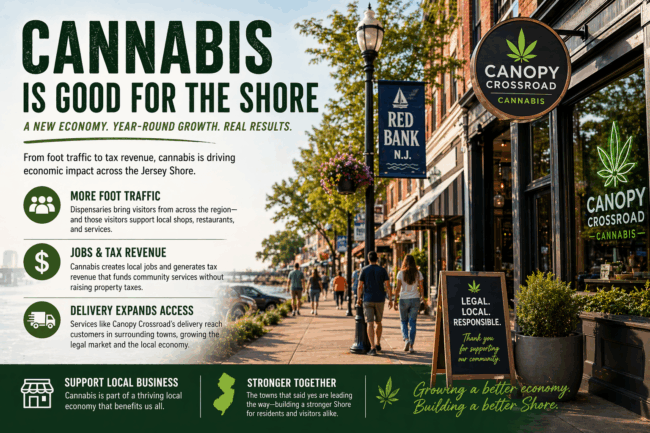
Table of Contents
The Towns That Said Yes Are Seeing Results
The Shore’s cannabis story is defined as much by the towns that said no as the ones that said yes. Across Monmouth and Ocean Counties, many municipalities passed ban ordinances quickly after legalization, leaving large stretches of the coastline without a single dispensary.
The towns that opted in — Red Bank being one of the most notable — absorbed that unmet demand. And the results are visible. Dispensaries in opt-in towns are drawing customers from well beyond their borders, and that traffic spills over to neighboring businesses. When someone drives twenty minutes to visit a dispensary, they often grab lunch, stop at a shop, or fill up on gas while they are there.
Delivery Extends the Reach
The next evolution is already underway. Dispensaries along the Shore are launching delivery services that extend their customer base even further into opt-out towns. This is significant because it turns what was already a regional draw into something even broader.
In Red Bank, Canopy Crossroad is a good example. As a women-owned dispensary that has built a loyal in-store following, they are now offering weed delivery in Red Bank, NJ that reaches customers across the surrounding area. For people in Monmouth County towns that banned dispensaries, this is the most convenient legal option — and for Canopy Crossroad, it is a way to serve a much larger market without needing a bigger storefront.
The Ripple Effect on Local Business
Cannabis is not operating in isolation along the Shore. The economic ripple effects are real, even if they are still early.
Commercial landlords in opt-in towns are seeing demand for retail space from cannabis operators, which supports property values and fills vacancies. Dispensaries hire locally — budtenders, delivery drivers, managers, compliance staff — creating jobs that did not exist a few years ago. And the tax revenue flows directly to the municipalities that opted in, funding local services without raising property taxes.
There is an indirect effect too. Dispensaries tend to draw a demographic that overlaps with the customers who frequent the Shore’s restaurants, boutiques, and entertainment venues. A dispensary is not replacing a bookstore — it is joining the same commercial ecosystem and contributing to its vitality.
What Small Business Owners Should Know
If you run a business in a Shore town that has opted in to cannabis, the arrival of dispensaries and delivery services is likely a net positive for you, even if you are not in the cannabis industry yourself. More foot traffic, more regional visitors, and a broader customer base are all benefits that flow from having a legal cannabis market nearby.
For small business owners in opt-out towns, the calculus is different. You may be watching customers drive to the next town over and taking their spending with them. That is a conversation worth having with your local government — not necessarily about whether cannabis is good or bad, but about where the economic activity is going and whether your town wants to participate.
To Sum It All Up
The Shore’s cannabis boom is still in its early innings. As delivery expands, as more consumers get comfortable with legal purchasing, and as the stigma continues to fade, the towns that built the infrastructure early will benefit the most. They have the customer relationships, the brand recognition, and the operational experience that latecomers will spend years trying to build.
For the Jersey Shore, cannabis is becoming what craft breweries became a decade ago — a draw that brings people in, supports local spending, and gives towns a new economic engine that works year-round, not just from Memorial Day to Labor Day.